Making the Artwork

Friday, 14 January 2011
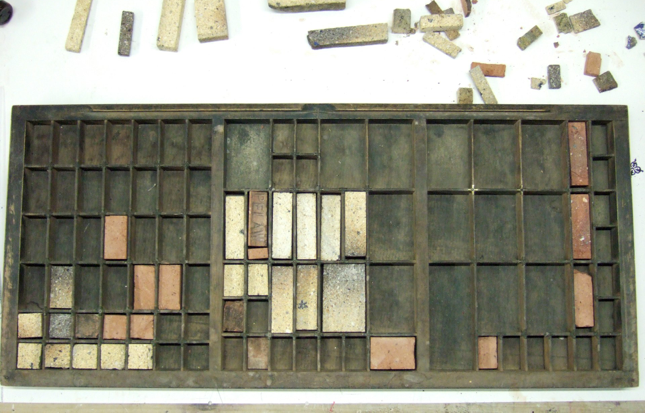
So far I have given few clues as to how all the research is to be resolved in an artwork.... This is partly because until recently I wasn’t at all sure myself. Originally it was in my thoughts that perhaps I would make a set of tableware for Gateshead - incorporating past present and future into some sort of common decorative border with differing picture planes on different items of the set... perhaps in the mode of the Cockle Pickers Tea Service I did a few years ago... but as the research went on this original idea became less and less palatable... What would be the nature of the tableware objects themselves? - Gateshead did have a pottery industry - George Patterson of Sheriff Hill, but although a street in the area (Potter’s Way) still references it, in reality it was overshadowed by Newcastle and Sunderland wares, and actually finding any of these sheriff hill pieces to work on was impossible - most of them were already printed on anyway. It seemed inappropriate to buy in white-ware made in Stoke - or what is more readily available now - from China. Then there was the business of bespoke patterns or vignettes - where do I start? Just so complex distilling Gateshead past present and future into visual iconography this way - it also seemed too contrived. No I needed something more flexible that would allow a greater freedom - and more space for all the references....
The artwork I had discussed and agreed with the Shipley was to be predominantly printed ceramic - after all that is the visual language that I use in most of my work - it is the work I am best known for. Then one day browsing through some of the old maps I had acquired in my research it dawned on me that the ceramic most prevalent in Gateshead was not printed tablewares, but brick. There were lots of brickworks here. They were partly a by-product of the coal industry - in many cases getting to coal seams involved digging through clay - and there was lots of coal in the area - the town exists because of it - The first record of coal being mined in the Gateshead area was in 1344, and their were staithes at Pipewellgate in 1349. The manors of Whickham and Gateshead became the best coal mining areas in Europe and were, of course, the envy of Newcastle merchants. ( From A Short History of Gateshead - Carlton, I. C. Gateshead Corporation 1974). Then the industrial revolution and the advent of steam engines (which cleared water from the lower coal seams) led to a new boom in the development of the town in the early nineteenth century.
I began to feel that - where possible - the material making up the artwork should actually be from Gateshead .... maybe clay or old bricks.... But then the question arose of the mechanism by which the clay and print would be presented. Just a collection of tiles made from local clay lacked a structure - how could a narrative be presented?
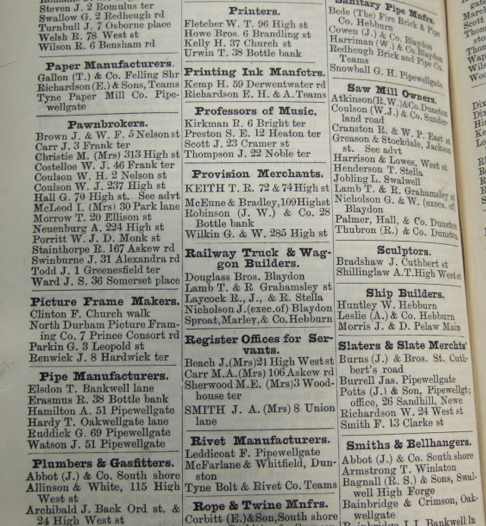
Then referencing Ward’s Trade Directory of 1883 - 1884 amongst the Railway Truck and Wagon builders, the Rivet, Rope and Twine Manufacturers, Shipbuilders, Smiths and Bellhangers I saw the Printers - Fletcher, Howe Bros, Kelly and Urwin. The artwork not only needed a material connection with the area, it needed an industrial reference - Gateshead in its present form exists because of the industrial revolution - the list of trades once practised here is extraordinary.
Back to the printers... in our conservatory we have an old printers letterpress tray - I pass by it every time I walk from my studio to the kitchen to make a cup of tea or get my lunch. I use it to house interesting objects and souvenirs of my travels - ant cleaned olive stones from a Greek beach, a shard of a pot lid from Adelaide , bendy rubber figures that my daughter used to play with when she was little, her painted stone, small bottles dug up in the garden, beer bottle tops, badges etc etc. Its a perfect form for storing, framing and displaying small objects...
I have several of these old trays bought on a whim one time in a second hand bookshop in Cockermouth - later supplemented by purchases on e-bay... these wooden forms could provide the perfect framing device for my tiles - made from old bricks and Gateshead clay...
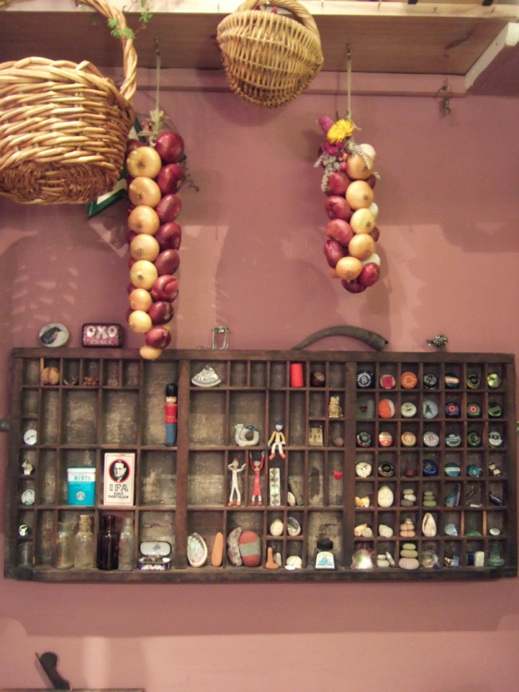



Above - very top - wooden tray with sliced bricks in studio... then wooden letterpress tray with objects - in the conservatory here in Holly Cottage, and two old trays selected to house the commission (one bought just this week from e-bay).
Below -
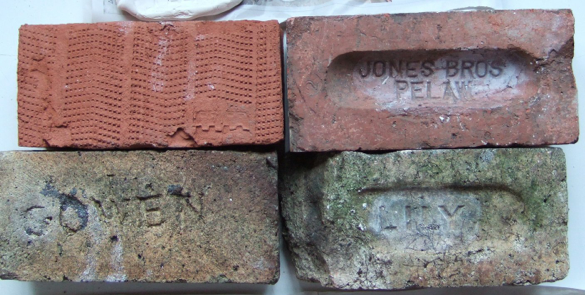
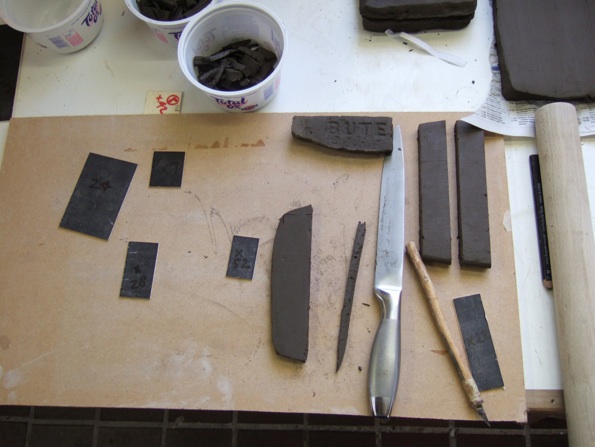
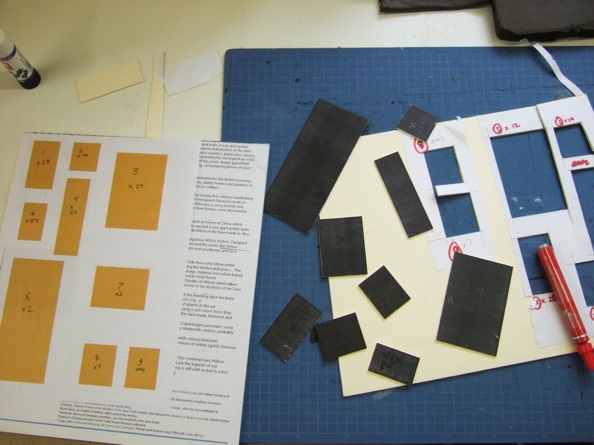
Gateshead bricks modern and old... templates for cutting bricks (orange) and brick clay (black - these are 9% larger than the actual finished tile - to allow for shrinkage in firing), then sliced bricks (cut on a water cooled tile bench cutter)... clay tiles ready for cutting to size and ready cut tiles drying....
More to follow another day.......


